

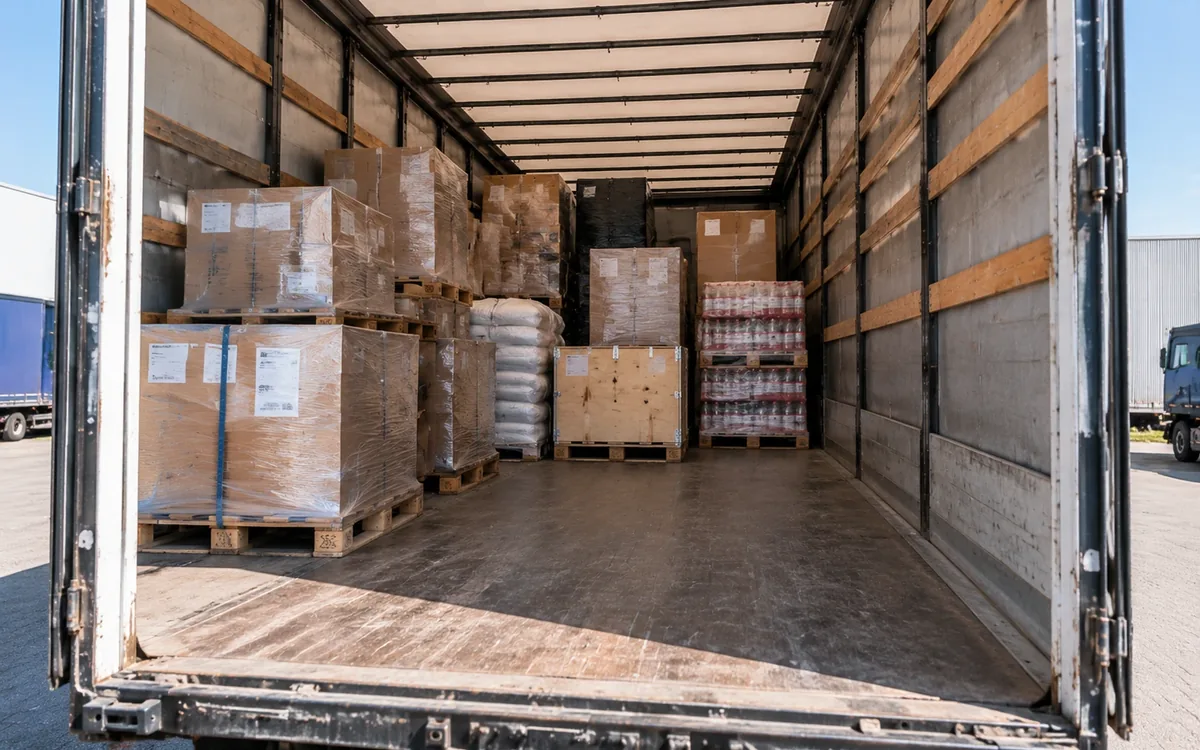
FTL is the whole truck for your cargo: a direct trip, faster and with no transhipment, but you pay for the entire semi-trailer. With LTL (part load) you pay only for your space, but the truck carries several customers’ goods and delivery usually takes longer. Rule of thumb: up to 4–5 LDM (10–12 euro pallets) a part load is almost always cheaper; from 5–8 LDM it is worth comparing both.
What FTL and LTL mean
FTL (Full Truck Load) — you book the whole truck. Only your cargo is on board, and the truck goes directly from loading to unloading. You pay for the entire semi-trailer, even if it is not completely full.
LTL (Less than Truck Load, part load, groupage) — your cargo takes part of the trailer, and the rest is filled with other customers’ goods. You pay only for your space: usually by loading metres (LDM) or by weight.
Side-by-side comparison
| FTL — full truck | LTL — part load | |
|---|---|---|
| Price | for the whole truck | only for your space (LDM or weight) |
| Transit time | direct trip — the fastest option | usually longer: the truck collects and delivers several shipments |
| Transhipment | none | depends on the set-up: goods are reloaded when routed via a warehouse |
| Risk of damage | minimal | higher when goods pass through warehouses |
| Loading date | to suit your schedule | to suit the groupage schedule |
| Best for | from ~14 euro pallets, urgent and valuable cargo, regular deliveries | from 1 pallet up to about a third of a truck, when timing is not critical |
Where the line is
There is no universal threshold: it depends on the route, the season and how full trucks are on the way back. But there is a rule of thumb:
- up to 4–5 LDM (up to 10–12 euro pallets) a part load is almost always cheaper;
- 5–8 LDM (14–20 euro pallets) is the comparison zone: ask for a price on both options;
- above 8–9 LDM (from 20–22 euro pallets) a part load costs nearly as much as a truck, while FTL is faster and more reliable.
You can work out the LDM of your cargo with our loading metre calculator.
When to choose a full truck (FTL)
- The cargo takes more than a third of the trailer or weighs more than 8–10 t.
- Timing matters: deliveries to a production line, a retail chain or an installation site.
- The goods are fragile, valuable or should not be handled more than necessary.
- You need loading on a specific day and at a specific time.
- You ship regularly — you can dedicate a truck and fix the rate.
When to choose a part load (LTL)
- The shipment is small: from one pallet to a few metres of trailer.
- Transit time is not critical and you have 1–3 days to spare.
- The goods are well packed and can travel next to other cargo and be reloaded.
- You send different consignments to different consignees.
A middle option: co-loading without warehouses
There is a set-up between FTL and LTL: your cargo shares a truck with another load going the same way, with no warehouses and no transhipment. We arrange this when your goods take a noticeable part of the truck but not enough for a full load. It costs less than a full truck and is almost as reliable.
Example: when it is time to switch to a full truck
Suppose you send 8–10 euro pallets from Germany to Spain once a week. That is 3–4 LDM, and a part load is the sensible choice. Then volumes grow to 20–24 pallets, i.e. 8–9.6 LDM. Now is the time to ask for a price on a dedicated truck: the difference from a part load is often small, and a direct trip is faster and involves no transhipment. With regular shipments you can dedicate a truck to your schedule and fix the rate for a period.
How to choose: three questions
- How many LDM and kilograms is your cargo? This tells you which zone you are in.
- How important is timing? If a delay costs money, compare prices with that risk in mind.
- How often do you ship? For regular shipments it pays to agree a schedule and a rate for a period.
Not sure which to choose? Describe your cargo in a request — we will price both options and tell you which is better on your route. More about our services: “Full truckload (FTL)” and “Part load (LTL)”.
Questions and answers
From what volume is a full truck cheaper?
As a guide, from 5–8 LDM (14–20 euro pallets) it is worth comparing prices. From 8–9 LDM a full truck is usually better value once speed is taken into account.
How much longer does a part load take?
Usually 1–3 days: the truck collects and delivers several shipments. The exact time depends on the route.
Can I send a single pallet?
Yes, a part load is possible from one pallet.
Is the cargo insured on a part load?
Yes, the carrier’s CMR liability applies just as it does for a full load.

Writes for shippers about trip planning, truck loading and paperwork.