

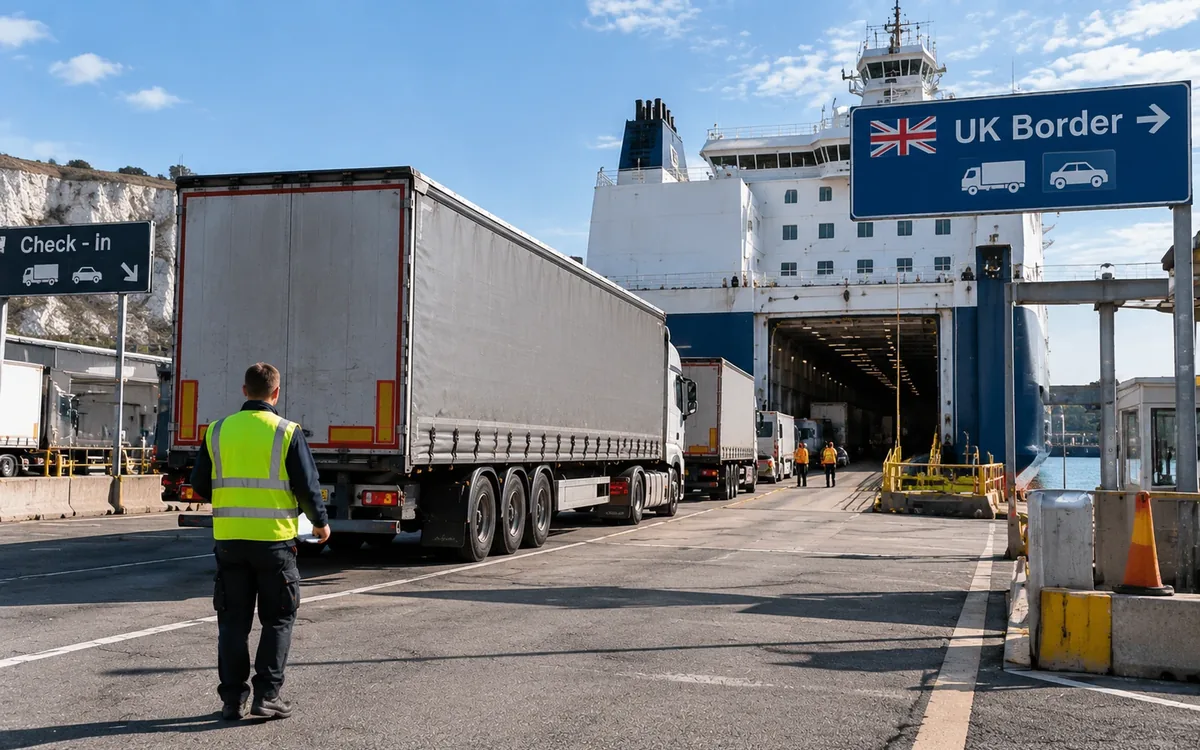
There is a customs border between the EU and the UK. A truck from the EU needs an export declaration in the country of dispatch, an import declaration in the UK, a safety and security declaration (ENS, mandatory since 31 January 2025) and a GMR number to board the ferry or the Channel Tunnel. The shipper and the consignee need EORI numbers, and a driver with an EU passport needs an Electronic Travel Authorisation (ETA).
What changed after Brexit
Since 1 January 2021 the United Kingdom has been outside the EU customs union and single market. Every consignment from the EU to the UK now crosses a customs border: it has to be released for export from the EU and cleared for import into the UK. The rules have been tightened step by step. The latest important changes for road freight:
- since 31 January 2025 a safety and security declaration (ENS) is mandatory for every consignment from the EU. By law, the carrier is responsible for submitting it;
- since 2 April 2025 drivers with an EU passport need an Electronic Travel Authorisation (ETA) to enter.
Documents: who prepares them and when
| Document | Purpose | Prepared by | When |
|---|---|---|---|
| EU EORI | exporter number for EU customs | shipper | in advance, once |
| UK (GB) EORI | importer number for UK customs | consignee | in advance, free on gov.uk |
| Export declaration (MRN) | release of goods from the EU | shipper or customs representative | before the truck leaves |
| Import declaration | import, duties and VAT in the UK | consignee or their broker | in advance — before boarding the ferry or train |
| Safety and security declaration (ENS) | security checks at the border | carrier (a representative may submit it) | before arriving at the border |
| GMR in GVMS | single movement reference for the ferry or the Channel Tunnel | carrier | before arriving at the port |
| Invoice, packing list, CMR | proof of goods, value and carriage | shipper and carrier | at loading |
| Driver’s passport and ETA | driver’s entry | driver | in advance |
Step by step: how a trip works
- Request. You tell us what you are shipping and to whom, the commodity codes (HS), value, origin and delivery terms (Incoterms): they determine who pays duties and VAT.
- EU export. The shipper or customs representative lodges the export declaration and receives an MRN.
- UK import. The consignee or their broker lodges the import declaration in advance.
- Security and GMR. The ENS is submitted, then a GMR is created in GVMS to link the truck to the declarations.
- Crossing. Most often Calais–Dover by ferry (about 1.5 hours) or by train through the Channel Tunnel (about 35 minutes). Without a valid GMR the truck will not be allowed to board.
- Release and delivery. If no inspection is ordered, the truck drives on to the consignee. The release result arrives in GVMS.
Duties and VAT
Under the EU–UK Trade and Cooperation Agreement (TCA), goods originating in the EU enter duty-free. This requires a statement on origin, usually on the invoice. If the goods cannot prove EU origin, duty may be payable.
Import VAT in the UK at the standard rate is 20%. Companies registered for VAT there can account for it on their VAT return instead of paying at the border — this is called postponed VAT accounting.
Food, plants and animal products
Products of animal and plant origin are subject to additional veterinary and phytosanitary requirements: certificates, pre-notifications and checks. We assess whether such goods can be carried case by case for each request.
How long it takes
The crossing itself takes from 35 minutes to a couple of hours. But it is worth adding about a day to the usual delivery time: port queues, boarding slots, possible inspections. If the declarations are lodged in advance, most of this time is just queueing.
Common mistakes
- The consignee has no UK EORI or has not appointed an import broker.
- The description, weight or number of packages on the invoice does not match the declaration and the CMR.
- Commodity codes and origin are missing — duty is charged where it might have been avoided.
- It is unclear who pays duties and VAT: the delivery terms were not agreed in advance.
- A driver with an EU passport has no ETA.
The return leg: from the UK to the EU
In the other direction everything mirrors: a UK export declaration, import in the EU country and an entry summary declaration for the EU in the ICS2 system. It is convenient to plan a return load from the UK together with the outbound trip.
What about Norway?
Norway is also outside the EU customs union, so export and import declarations are required. Since 15 September 2026 Norwegian Customs requires a digital advance notification of every consignment and vehicle in the Digitoll system. More on our transport to Norway page.
How we work
We run trucks to the UK on request and handle customs clearance together with a customs representative: export and import declarations, ENS and GMR. From you we need the invoice, packing list, commodity codes and consignee details. If something is not ready yet, we will tell you what is needed and where to get it. More on our transport to the UK page.
Questions and answers
Does the consignee need a UK EORI?
Yes. The UK importer needs an EORI number starting with GB — it is issued free of charge on gov.uk.
Who submits the ENS safety and security declaration?
By law, the carrier is responsible for it. A representative, such as a customs broker, can also submit it.
Does the driver need a visa?
A driver with an EU passport needs an Electronic Travel Authorisation (ETA), not a visa. For other nationalities, requirements depend on citizenship.
Are duties payable?
Not for goods of EU origin with a statement on origin. Import VAT at the standard rate is 20%.
Sources
- GOV.UK: safety and security declaration requirements for goods from the EU
- GOV.UK: Goods Vehicle Movement Service (GVMS)
- GOV.UK: get an EORI number
- Home Office: Electronic Travel Authorisation (ETA) factsheet
- Norwegian Customs: Digitoll obligations

Writes for shippers about trip planning, truck loading and paperwork.