

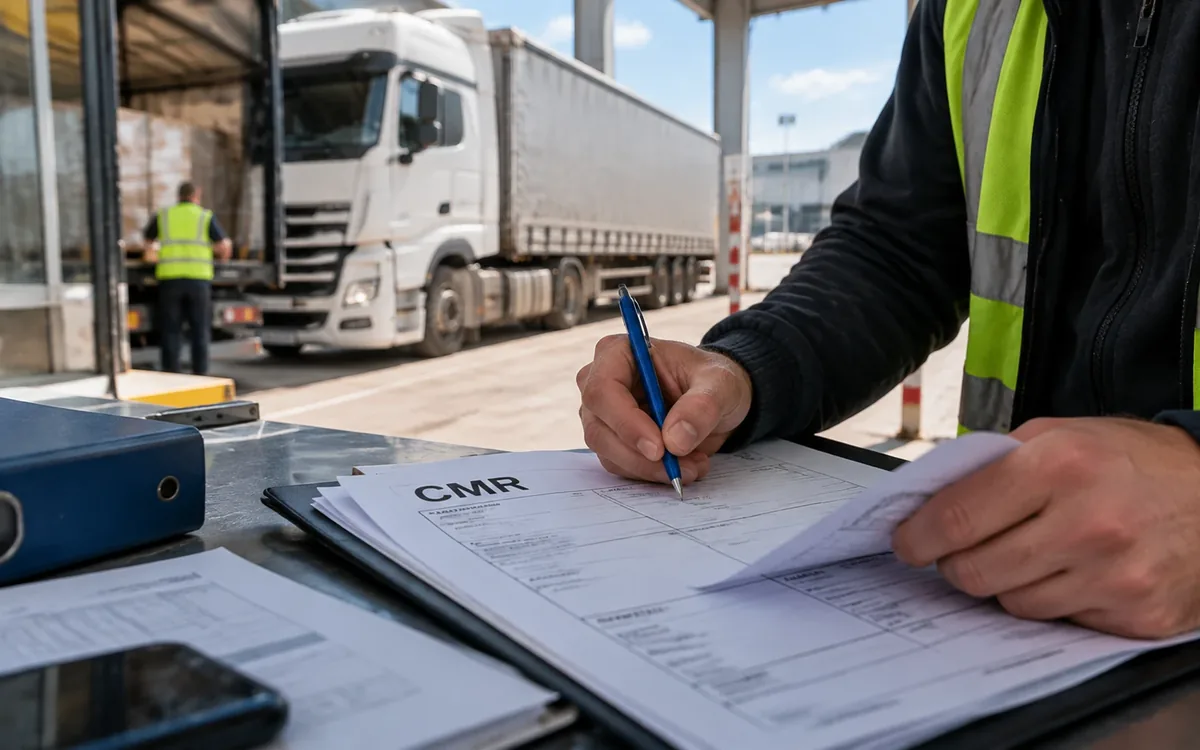
The CMR consignment note is the main document of international road freight under the 1956 CMR Convention. It is signed by the sender and the carrier, and by the consignee at unloading. The carrier is liable for loss of and damage to the goods up to 8.33 SDR per kilogram of gross weight — about €9.9 per kg at the rate of 25 September 2026. If the goods are worth more, you need cargo insurance or a declared value.
What CMR is
CMR is the Convention on the Contract for the International Carriage of Goods by Road, signed in Geneva in 1956. It applies to the carriage of goods by road for payment when the place of loading and the place of delivery are in different countries and at least one of them is a party to the Convention. All EU countries are parties, as are the United Kingdom, Norway, Switzerland, Ukraine and many others.
The CMR consignment note is the document that confirms the contract of carriage and travels with the goods. It shows what is being carried, how much, from whom and to whom, and in what condition the goods were taken over and delivered.
Who fills in the consignment note
Under the Convention, the sender is responsible for the accuracy of the details about the goods. In practice the form is often prepared by the sender or the forwarder, and at loading the carrier checks the number of packages and their apparent condition. If something is wrong, the carrier enters a reservation on the note.
| Box | Content | Filled in by |
|---|---|---|
| 1–2 | sender and consignee | sender |
| 3–4 | place of delivery; place and date of loading | sender |
| 5 | documents attached (invoice, certificates) | sender |
| 6–12 | marks, number of packages, packing, description of goods, gross weight, volume | sender |
| 16–17 | carrier and successive carriers | carrier |
| 18 | carrier’s reservations at loading | carrier |
| 22–23 | signatures and stamps of sender and carrier | sender and carrier |
| 24 | receipt of the goods and consignee’s reservations | consignee |
Box numbers follow the common standard form. They may differ slightly on other forms.
How many copies are needed
The Convention requires three originals signed by the sender and the carrier. The first stays with the sender, the second travels with the goods and is handed to the consignee, and the third stays with the carrier. In practice a fourth copy is often printed for the forwarder or the accounts department.
More and more countries accept the electronic consignment note, e-CMR, under the 2008 Additional Protocol to the Convention. It is legally equivalent to the paper note if both countries of the carriage have acceded to the Protocol.
Carrier liability: what you get if goods are lost
The carrier is liable for loss of and damage to the goods from the moment it takes them over until delivery, and also for delay. But compensation is capped: no more than 8.33 SDR per kilogram of gross weight of the goods lost or damaged. The SDR is a unit of account of the International Monetary Fund. At the rate of 25 September 2026, 1 SDR = €1.1927, so the limit is about €9.9 per kg.
| Cargo | Gross weight | Limit, SDR | ≈ in euros |
|---|---|---|---|
| 1 pallet | 500 kg | 4,165 | ≈ €4,970 |
| 10 pallets of 700 kg | 7,000 kg | 58,310 | ≈ €69,550 |
| Full truck | 25,000 kg | 208,250 | ≈ €248,400 |
In addition, the carriage charges, customs duties and other charges incurred in respect of the carriage of the lost goods are refunded. Compensation for delay cannot exceed the carriage charges.
Carrier’s insurance and cargo insurance are not the same
CMR carrier’s liability insurance covers what the carrier is liable for under the Convention — within its limits. Ours covers up to €300,000 per trip. But the policy does not raise the 8.33 SDR per kg limit. If you need protection for the full value of the goods, separate cargo insurance is taken out.
The Convention also lists cases in which the carrier is not liable. For example, if the damage is caused by insufficient packing, or by loading or stowage carried out by the sender, or by the inherent nature of the goods. That is why packing and securing are a shared responsibility.
Deadlines: how not to lose the right to claim
| Situation | What to do | Deadline |
|---|---|---|
| Visible damage or shortage | enter a reservation on the consignment note (box 24), take photos and sign together with the driver | immediately on delivery |
| Hidden damage | send the carrier a written claim | 7 days, excluding Sundays and public holidays |
| Delay in delivery | send a written claim | 21 days from when the goods were placed at the consignee’s disposal |
| Legal action | file a lawsuit | 1 year; 3 years in case of wilful misconduct or equivalent default |
Sender’s checklist
- Check that the number of packages and the weight on the note match the actual load and the invoice.
- If the driver enters a reservation (for example, “packaging damaged”), sort it out before departure, not afterwards.
- For valuable cargo, decide on insurance or a declared value in advance.
- Ask the consignee to check the goods at unloading and write any remarks on the note.
- Keep your copy of the note: without it, it is harder to prove the goods were handed over in good order.
How we work
We carry goods with our own fleet. At loading the driver checks the number of packages and the condition of the goods, and after delivery you receive the signed CMR. Our carrier’s liability is insured under CMR up to €300,000 per trip. For valuable cargo, we will advise in advance whether additional insurance is needed.
Questions and answers
Is a CMR needed for domestic transport?
The Convention applies to international carriage. Within a single country, national rules apply.
Can the consignment note be electronic?
Yes, e-CMR is recognised in countries that have acceded to the 2008 Additional Protocol. That is already most of the EU.
What is the liability limit in euros?
8.33 SDR per kg — about €9.9 per kg at the rate of 25 September 2026. For a full 25 t truck that is about €248,400.
Who enters reservations on the note?
At loading, the carrier (box 18); at unloading, the consignee (box 24).
Sources

Writes for shippers about trip planning, truck loading and paperwork.